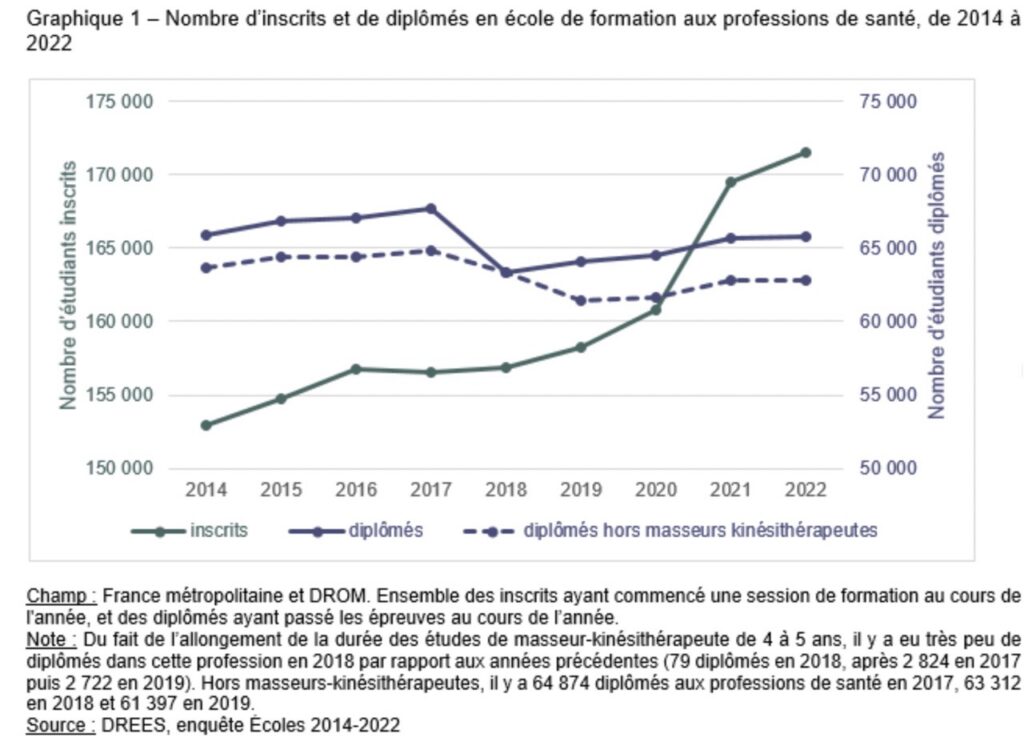
With the growing supply of private prep schools following the reform of the first cycle of health studies, their presence has intensified, not only within secondary schools but also in university-level discourse. The message is clear: prep school is seen as an essential success factor, and not using one would mean giving up essential support in the face of ever fiercer competition. This perception has led to a situation where, for many students, attending a prep school has become the norm, even a necessity, reinforcing the idea that success in health studies requires this costly and sometimes unevenly accessible step.
In this context, medical prep schools need to find ways to meet the growing demand for support, while adapting their methods so as not to worsen inequalities in access. The hybrid model, combining remote and in-person classes, could offer a more flexible, accessible alternative, while maintaining the effectiveness of the preparation. This model, which increases available spots without sacrificing teaching quality, is emerging as an innovative solution to meet the needs of a new generation of medical students.
The evolution of medical prep school: toward hybridizing teaching methods
Medical prep schools have long relied on a traditional teaching model, where preparation for entrance exams mainly happened in person, with intensive classes, review sessions, and regular assessments. However, with the exponential rise in the number of students wanting to access these programs, capacity limits have been reached. This has required rethinking teaching methods, to accommodate this growing demand while maintaining teaching effectiveness.
The hybrid prep school model then emerges as a promising solution. It combines the best of both worlds: the rigor and commitment of in-person learning, and the flexibility and accessibility of remote learning. This model relies on digital technology that maintains a high level of interactivity and personalization in learning, while significantly increasing capacity.
Remote classes: a lever for increasing capacity in medical prep school
Remote classes play a key role in expanding the possibilities offered by hybrid medical prep schools. Thanks to digital and communication technology such as online teaching platforms, students can follow classes from anywhere, at any time, while still benefiting from genuine, interactive follow-up. Hybrid classes, delivered synchronously or asynchronously, offer real flexibility for these prep schools in the digital age. What’s more, lectures and tutorials can be recorded and made available at any time for students to review concepts they didn’t fully grasp in class.
The flexibility offered by these online classes is a major asset for medical prep schools. It makes it possible to adapt teaching methods and learning pace to each student’s individual needs. As a result, prep schools can accommodate more students without needing to physically expand their classrooms. This model also promotes accessibility and inclusion, opening opportunities to students who, for logistical or financial reasons, couldn’t otherwise attend in-person sessions.
For the hybrid medical prep school model to be fully effective, it’s crucial to deploy suitable infrastructure and advanced technology. It’s essential for schools and prep programs to turn their classrooms into genuine hybrid spaces, not just settle for adding a basic video conferencing system, which would risk hurting students’ learning experience.
How do you set up a hybrid training room in a medical prep school?
Hybridizing teaching in a medical prep school means installing a hybrid room equipped with a high-definition camera, a high-performance microphone, and an interactive touchscreen, paired with automated broadcasting software: Kapture. This software connects directly to the institution’s schedule to automatically start video sessions and publish them online for enrolled students, live and synchronously, then asynchronously on demand.
The initial investment, which ranges between €4,000 and €15,000 depending on the equipment chosen (screen size, microphone quality, camera quality), is largely paid back by the increase in enrollments from the very first year.
The hybrid room recreates the in-person experience as immersively as possible, while offering the flexibility needed for remote learning.
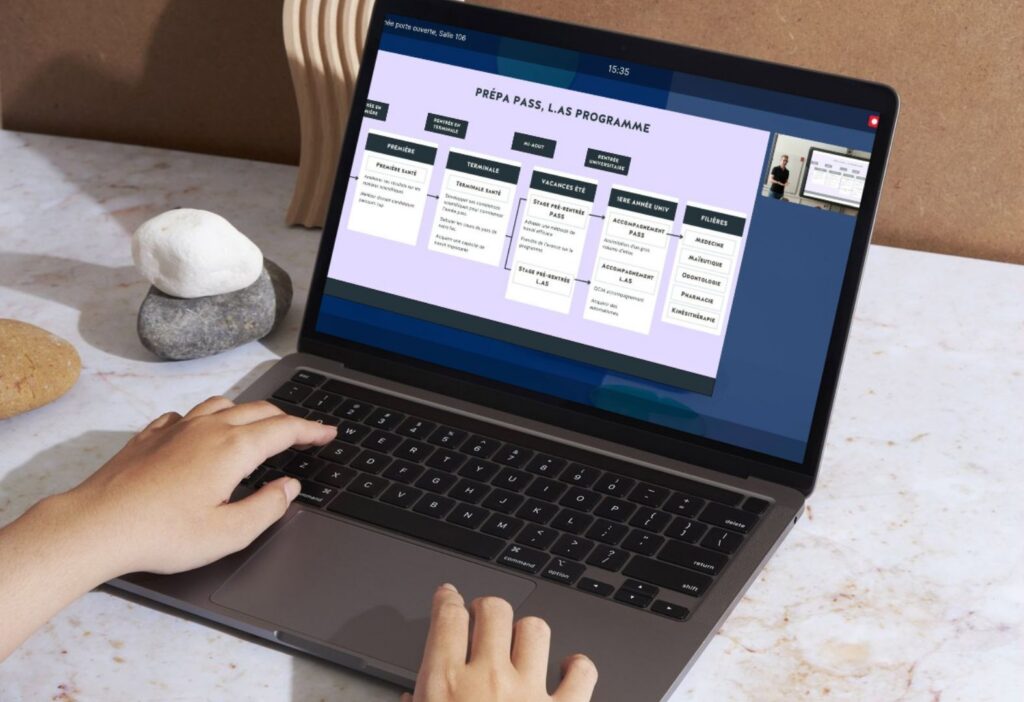
About the software: Kapture is a cutting-edge ed-tech solution that captures, broadcasts, and manages online classes smoothly and interactively. This software was designed to make it easier to access teaching content, giving students the ability to review classes at any time, interact with teachers during live sessions, and take part in assessments. What’s more, Kapture lets teachers free themselves from technical constraints by automating recurring tasks, such as scheduling sessions, which can be managed manually or automatically, depending on needs.
Challenges and future outlook for hybrid medical prep schools
While the hybrid model offers many benefits, scheduling, resource management, and coordinating between in-person and remote sessions require careful planning. It’s also necessary to ensure teaching consistency across the different formats, so students get a uniform, thorough preparation.
That said, the prospects offered by hybrid medical prep schools are vast. As digital technology keeps evolving, these prep schools will be able to offer increasingly interactive, personalized learning experiences. Wider adoption of this model could also lead to greater democratization of access to medical studies, letting more students benefit from quality preparation.
Ultimately, the hybrid medical prep school model represents a promising answer to the growing demand for enrollment in medical training programs. By combining remote and in-person classes, these prep schools not only increase capacity, but also diversify learning and assessment formats. Integrating innovative software like KAPTURE, and deploying suitable equipment, play a crucial role in the success of this model.