Press release: Kalyzée’s ideal HyFlex classroom adopted by the “Connected French Guiana: Bridging the Gaps” project, winner of the “Innovation in School Formats” call for expressions of interest.
Kalyzée, Marseille, France – How do you keep students from isolated villages in French Guiana within their socio-cultural environment? That’s the whole ambition of the “Connected French Guiana: Bridging the Gaps” project, led by the French Guiana regional education authority, winner of the “Innovation in School Formats” call for expressions of interest. Kalyzée provides an innovative ed-tech answer with the ideal HyFlex classroom.
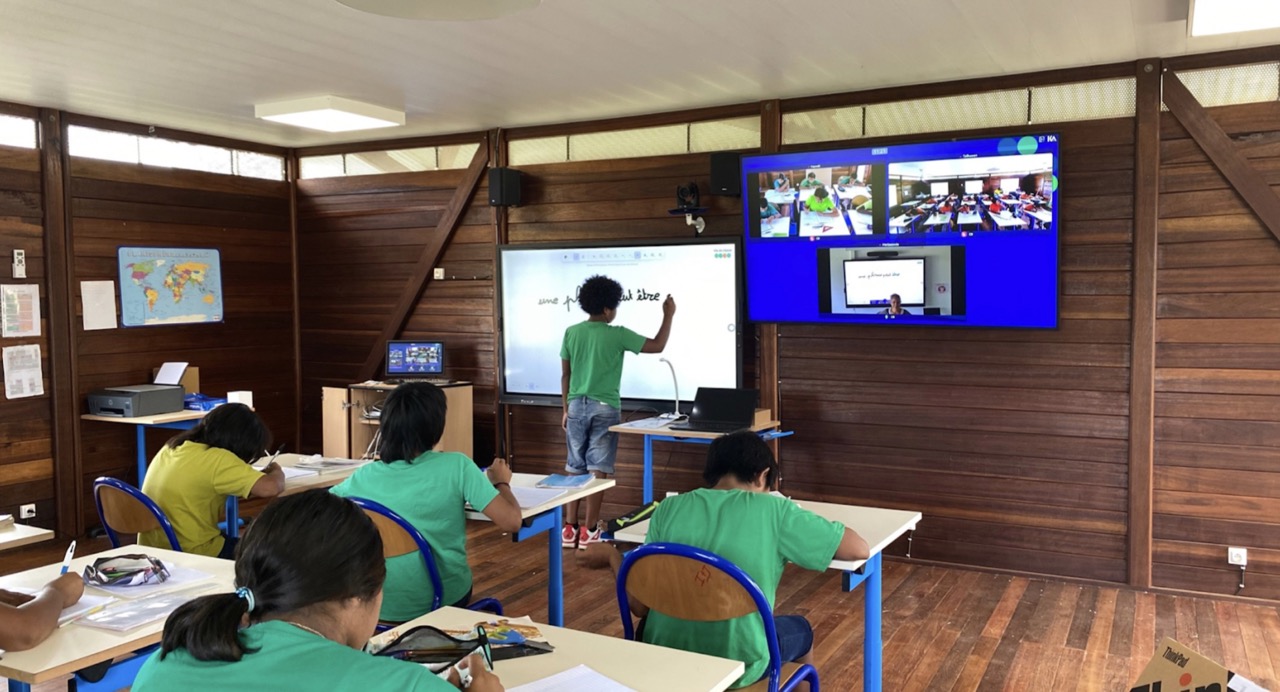
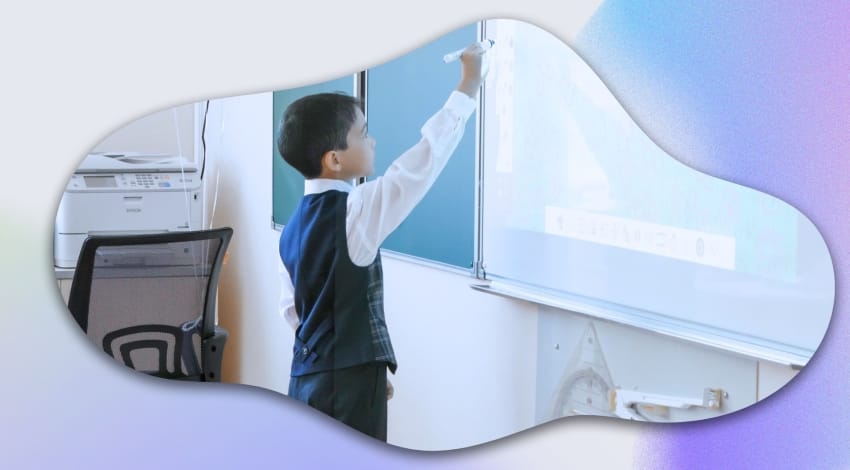
Classroom set up in the village of Taluen, on the riverbank, connected live to the secondary school in Maripasoula
The challenge facing students in French Guiana’s isolated villages is the geographic distance between their village and the secondary school. Some students have to spend up to three hours a day traveling by canoe to get to class. It’s a dangerous, costly, and sometimes very long journey, leading to serious issues (dropping out, absenteeism, being uprooted from family, and suicide).
The Connected French Guiana project involves setting up sixth- and seventh-grade classes directly within isolated villages (“écarts”), using a particularly innovative ed-tech approach. This allows for a smooth transition between schooling in these remote villages and when young students arrive at institutions in the towns and along the coast of French Guiana.
In concrete terms, students will follow the same class, in the same classroom, from remote locations. They’ll be able to exchange in real time and remotely with the various teachers and all the groups making up the class. This will help students better understand what secondary school expects of them, while staying as close as possible to their family, cultural, and social environment.
Kalyzée’s ideal HyFlex classroom being rolled out at the heart of the Guianese Amazon….
Kalyzée, a partner in this large-scale project, is rolling out its ideal HyFlex classroom concept to improve access to education in remote villages in French Guiana. Innovative, custom-built technology has been developed for the project.
This technological innovation is built on developments by Kalyzée, a Young Innovative Company, which, using a geostationary satellite, will make it possible to interconnect the classrooms. The first classes will open in Taluen, Antecume Pata, Kayodé, and Maripasoula starting with the 2023 school year.
The ideal HyFlex classroom: a technological and pedagogical challenge.
Kalyzée is fully committed to this project. The context, the stakes, and the operational conditions all make it truly exceptional. What’s more, the environmental constraints (electricity, networks, humidity) represent a motivating technological challenge.
“The whole Kalyzée team is thrilled at the idea of taking on this challenge. It’s an incredible opportunity for the startup to demonstrate its ability to build sovereign, resilient communication solutions. If we succeed in French Guiana, we’ll succeed anywhere — in France, of course, but also in the rest of the world where access to power grids and the internet is limited!” says CEO Stéphane Barbati.
After 6 months of R&D, Kalyzée has just validated its proof of concept: connecting 4 remote classrooms via a very-low-bandwidth satellite connection. A teacher can deliver a class simultaneously across 4 remote rooms, while keeping teacher-student interaction intact. To achieve this, the startup created a new low-power, low-bandwidth communication architecture using its own cameras. The innovation in the Connected French Guiana project touches on both teaching practice and technology.
These classrooms, which combine in-person and remote attendance at the same time, change teachers’ role and approach. As a result, models for sequencing classes and running multi-site sessions had to be developed. This task was entrusted to a research team from the INSPE at Aix-Marseille University.
The ideal HyFlex classroom: the future standard for online training?
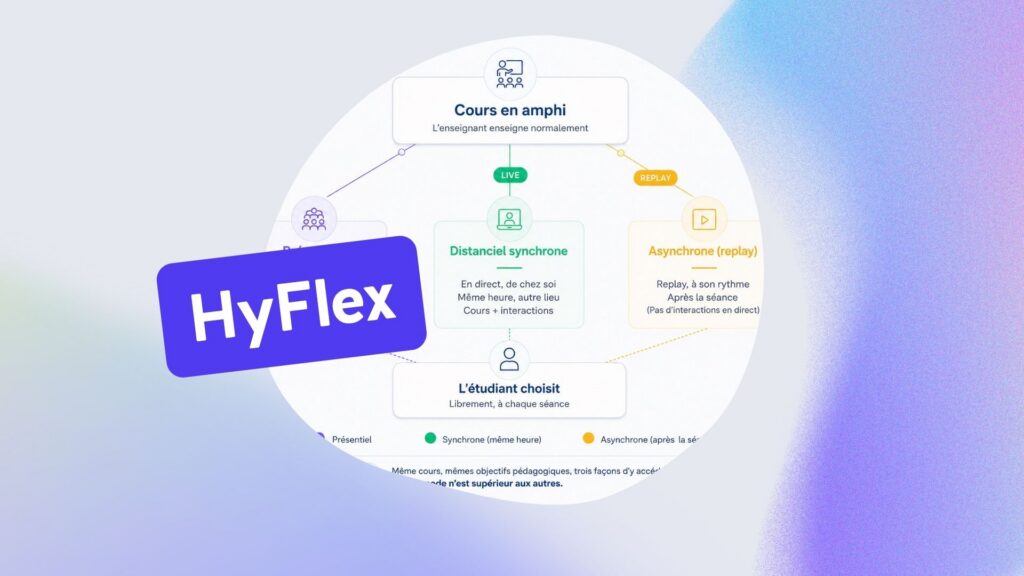
The ideal HyFlex classroom is a concept born from observation and expertise built over 10 years working with our clients and partners. This classroom meets the need for both synchronous and asynchronous, in-person and remote hybridization.
The ideal HyFlex classroom has been carefully designed and laid out to offer the best experience currently on the market. This classroom stands out both for how simple it is to use (1 hour of training) and for its tightly controlled cost (under €40,000).
We’re making the reference plan (wiring diagram) available here under Creative Commons (CC BY 4.0). Anyone is free to use and modify it.
Kalyzée’s unique feature is mastering both the technical and pedagogical sides — two worlds that, in the field, usually talk to each other very little, if at all. The ideal HyFlex classroom perfectly meets the requirements of both technicians and educators:
• This classroom integrates with existing ecosystems: Moodle, BBB, ESUP-POD, Canal-U;
• This classroom handles video conferencing, streaming, and broadcast at the same time;
• Its startup and use are fully automated and supervised, freeing teachers from technical constraints;
In “ideal HyFlex classroom,” the word “ideal” means customization of the classroom for each situation. Starting from the standard classroom model, variants can be created based on specific needs. This is exactly the case with the Connected French Guiana project, for which satellite network connections were factored in.
Finally, “ideal” also means factoring in CSR policy. Kalyzée puts cameras other than its own KAST brand (Aver or Polycom) back into circulation, integrating them into the ideal HyFlex classroom.
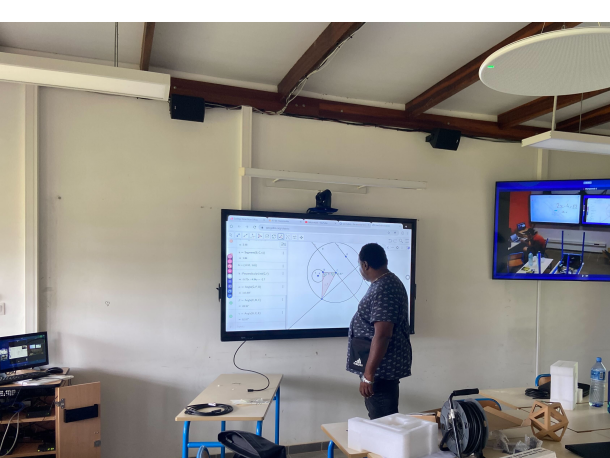 Proof of concept and ongoing rollout of an ideal HyFlex classroom in Maripasoula, French Guiana.
The ideal HyFlex classroom could well set the new standard for hybrid training. Any room can be transformed to be interconnected with another, whatever communication protocols are chosen.
With the rollout of low-orbit satellites and 5G, many possibilities are opening up. It becomes possible to create and connect third places located in network dead zones, for example. Remote learners, isolated individually or as a group, can now communicate with the teacher/trainer as well as with other remote students, with everyone able to interact on the shared whiteboard.
Offering a remote, hybrid experience similar to being in person, with classrooms designed and configured for total immersion of remote students in the class, with an unmatched experience, is exactly what the ideal HyFlex classroom is all about.
Dear reader, THANK YOU for reading this far — it gives real meaning to what we do.