You already have the case for a HyFlex classroom in mind. You know it’s useful, that your students or learners need it, that your competitors are moving in that direction. But convincing leadership, a board, or a finance director is a different challenge altogether.
It’s not a matter of common sense. It’s a matter of language. Leadership doesn’t think in terms of “teaching experience” — they think in budget lines, risk, and return on investment. Your case for a HyFlex classroom needs to speak that language, without losing what makes the project valuable.
In this article, we give you the 5 points of a solid case for a HyFlex classroom, the objections you’ll hear, and the answers that hold up.
1. The case for a HyFlex classroom starts with a problem, not a solution
The first mistake in a case for a HyFlex classroom: showing up with the equipment before the problem. “We’d like to equip 3 rooms for hybrid teaching” — that’s a budget request, not a case.
An effective case for a HyFlex classroom always starts from a situation your leadership already recognizes:
- Specialized guest lecturers who refuse to travel between several campuses
- Overcrowded lecture halls while remote students could follow the same class
- A rising dropout rate on long or intensive programs
- Competitors already offering a hybrid program and drawing in your potential applicants
State the problem first. The HyFlex classroom comes as the answer — not as the question.
2. Put a number on what doing nothing costs
This is the most powerful argument in a case for a HyFlex classroom — and the least often used. People always present the cost of the project. Rarely the cost of inaction.
Yet continuing to operate without a HyFlex classroom has a real cost:
- Every time a guest lecturer travels between campuses, it costs between €200 and €800 depending on distance and status. With 20 lecturers making 10 trips a year, that’s already €40,000 to €160,000 annually.
- Every student who drops a paid program for lack of flexibility is lost revenue. For a €3,000 program with a 10% dropout rate, 10 fewer learners means €30,000 that never comes in.
- Every applicant who chooses a competitor offering quality remote learning is market share given up quietly.
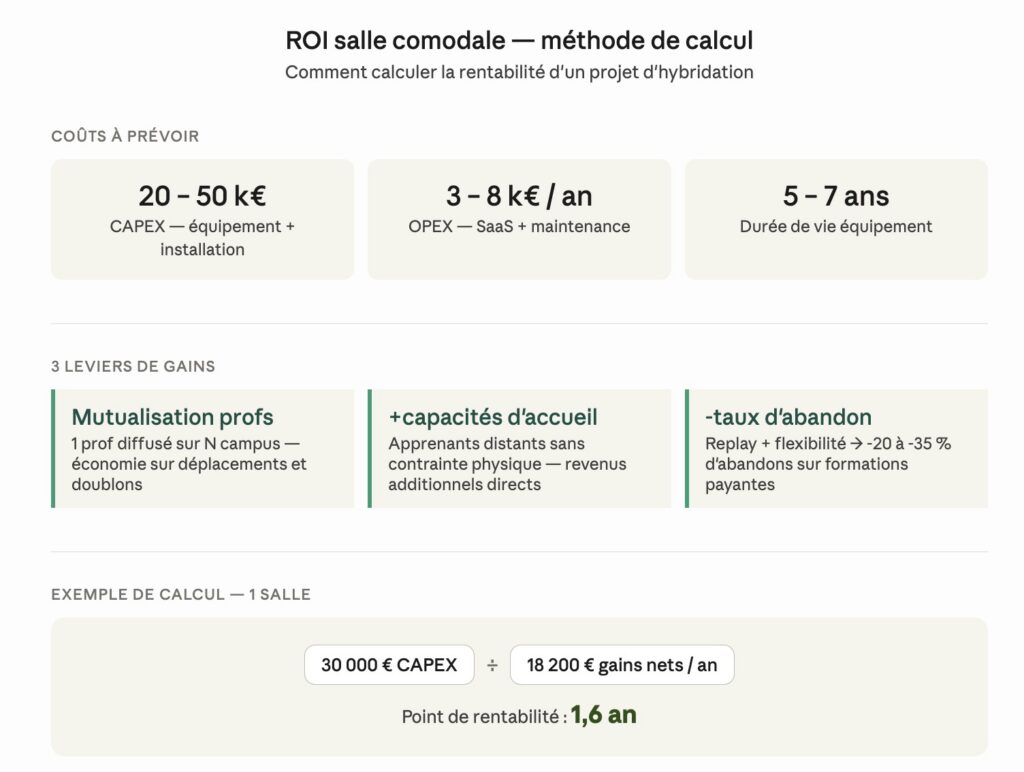
In your case for a HyFlex classroom, put this figure side by side with the cost of the project. In most cases, the status quo costs more than the equipment, and the ROI of a HyFlex classroom is fairly simple to calculate.
3. Show that the risk is under control
Leadership doesn’t get stuck on an idea because they don’t understand it. They get stuck because they don’t have an answer to the questions they don’t dare ask.
A solid case for a HyFlex classroom anticipates these questions:
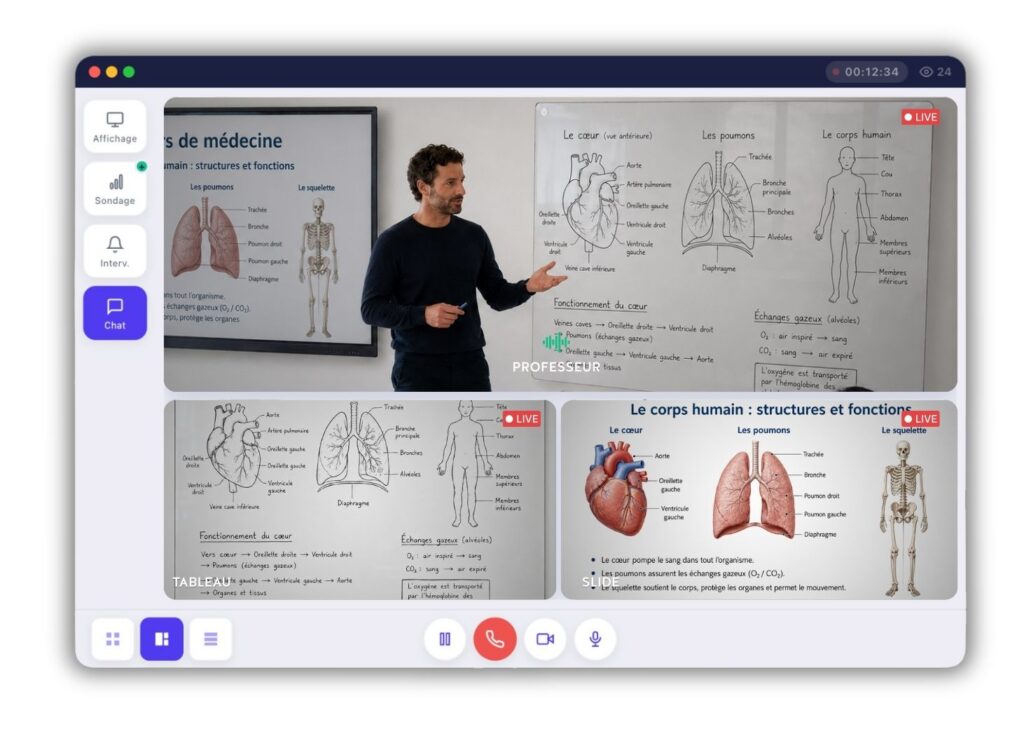
“What if teachers don’t use it?“ This is objection number one. The answer: a well-deployed HyFlex classroom is designed to change nothing about the teacher’s habits. The teacher walks into the room, clicks on their class in the calendar, and they’re off. No cabling, no control room, no mandatory technical training. Adoption follows naturally.
“Does it integrate with our LMS / student portal?“ The answer needs to be precise. List the integrations available with the solution you’re proposing. Moodle, Canvas, Blackboard, itslearning — serious solutions all integrate. Prepare the answer before you’re in the meeting.
“What do we do if it breaks down in the middle of a class?“ Get ahead of the support question. A contract with a 4-hour response commitment, a human hotline, and a planned fallback mode — these turn a blocking objection into a settled point.
4. Back up your case for a HyFlex classroom with concrete examples
An abstract figure convinces less than a real situation. Your case for a HyFlex classroom gets stronger with every concrete reference you can cite.
A few examples that speak to leadership:
- A university that equipped 3 interconnected lecture halls across two campuses and cut guest lecturer travel costs by 40% in the first year
- A prep school group that opened its program to students in other regions without creating a single extra position
- A regional education authority that solved the issue of educational continuity across a remote territory with a HyFlex infrastructure deployed in under 6 months.
These cases exist. If you don’t have them in your own network, the public references from solutions like Kalyzée (University of Reims, University of Montpellier, French Guiana regional education authority) can serve as a basis for your case for a HyFlex classroom.
5. Propose a gradual rollout, not a full deployment
The case for a HyFlex classroom often fails on the ambition of the initial project. Proposing 10 rooms to equip right away means proposing a risk. Proposing 1 pilot room at the most strategic site, with a review after 6 months, means proposing a reasonable decision.
Leadership will rarely say no to a well-scoped pilot:
- 1 room, on the busiest campus
- A semester-long test with indicators defined in advance (usage rate, teacher satisfaction, number of remote learners connected)
- A numbers-based review before deciding on a wider rollout
This approach reduces perceived risk, builds an internal track record, and gives your leadership an easy decision to make. That’s often how the most ambitious projects begin.
The most common objections — and how to answer them
“We don’t have the budget this year.” Answer: present the cost as monthly OPEX rather than total CAPEX. €150 per room per month is an operating line item — not a capitalized investment. And if the equipment budget is stuck, check available funding: FEDER, France 2030, regional grants. Many HyFlex classroom projects have been 50 to 80% funded by public money.
“We already have Teams / Zoom.” Answer: Teams and Zoom solve video conferencing. Not automatic multi-feed capture, not integration with the institution’s schedule, not VOD indexed in the LMS, not automatic attendance tracking. These are two different tools that meet two different needs. A case for a HyFlex classroom needs to make that distinction clear.
“Students need to come to class.” Answer: HyFlex teaching doesn’t replace in-person attendance. It lets those who can’t come — for health reasons, distance, or professional or family constraints — avoid falling behind. Students who can come keep coming. Those who can’t have a genuine educational alternative.
Where should your case for a HyFlex classroom start?
A convincing case for a HyFlex classroom fits on one page. Here’s the structure:
- The problem: 2 or 3 observations your leadership already recognizes
- The cost of inaction: an estimated figure, even a rough one
- The solution: 1 pilot room, not a full rollout
- The references: 1 or 2 concrete cases in a context similar to yours
- The controlled risk: integration, support, adoption
If you want to build this case for a HyFlex classroom using your own real numbers, the Kalyzée team can work through the exercise with you in 30 minutes — that’s exactly what we do during a free assessment.
Kalyzée has been supporting higher education institutions and training centers in their transition to HyFlex teaching since 2014. More than 500 rooms equipped, 1.2 million hours of classes streamed.