Going beyond simple retransmission
Video conferencing provided valuable educational continuity during the health crisis. It managed to reconnect trainers and remote learners, offering a live communication solution well suited to a time when everyone was at home. However, video conferencing hits its limits in an in-person classroom. The class experience tends to differ between in-person and remote participants. In fact, common issues include:
- Poor visibility of the board and course materials
- Insufficient audio quality when the teacher moves around the room
- Poor audio quality for questions asked in the room, or questions not being heard at all
- A feeling of being “left behind” among remote learners, with declining engagement
Hybridizing a training program requires a more holistic approach than simple video conferencing. The goal is to create a unified learning environment. Every participant, wherever they are, should feel fully involved, immersed in the classroom.
The foundations of a blended learning experience: the ideal hybridization
Turning a traditional training space into an effective hybrid learning space rests on several pillars. The goal is to make remote learning just as high quality as in-person learning, while optimizing the trainer’s experience.
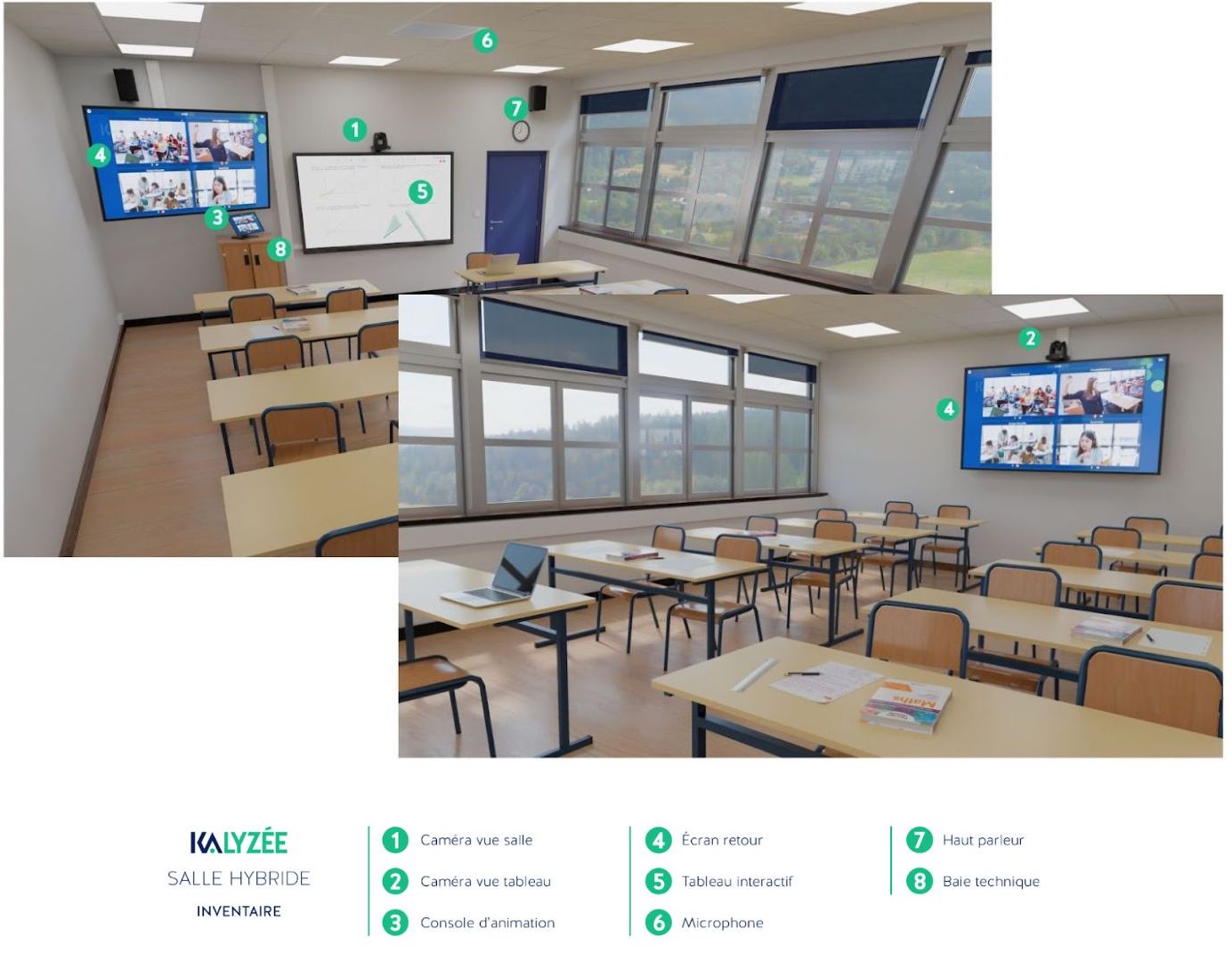
Careful audiovisual capture
Video quality is essential. Installing a camera at the back of the room is essential, but not necessarily enough. For genuine immersion of remote learners, adding a second camera to film the room is strongly recommended. Finally, it’s absolutely essential to broadcast course content digitally — you don’t film a board, you broadcast the digital feed directly.
Some broadcasting software lets the learner choose which feed to display, for greater flexibility.
Audio quality, at the heart of hybrid training
Audio deserves similar attention. Discreet ceiling microphones ensure clear sound capture. Every word from the teacher and from learners in the room is audible to those remote. Conversely, remote contributions are broadcast clearly into the room. For a ceiling microphone, either suspended or in tile form, expect to pay between 1,000 and 4,000 euros depending on the microphone’s precision. For example, Shure ceiling tiles reduce background noise, spatialize sound, and can focus on the teacher’s voice, for example — cutting-edge technology that comes at a price. For more modest budgets, we strongly recommend the Vaddio range, which delivers more than enough quality for a hybrid training room. All the microphones we recommend use the standardized DANTE protocol to connect to the local network.
Interactivity front and center
A truly effective blended teaching setup fuels exchange. Interactive whiteboards become tools for co-creation. Solutions such as the Samsung WA75F or the Newline Elara Pro make this collaborative work easier.
Trainers and learners, whether present or remote, annotate together using the free Kalyzée whiteboard app. They share ideas and collaborate on a single, shared surface.
Having confidence monitors in the physical room also changes the game. The trainer can see remote participants without turning away or checking their computer. Learners on-site also interact more naturally with their connected peers. This setup ensures no one feels isolated.
Toward the ideal HyFlex training room
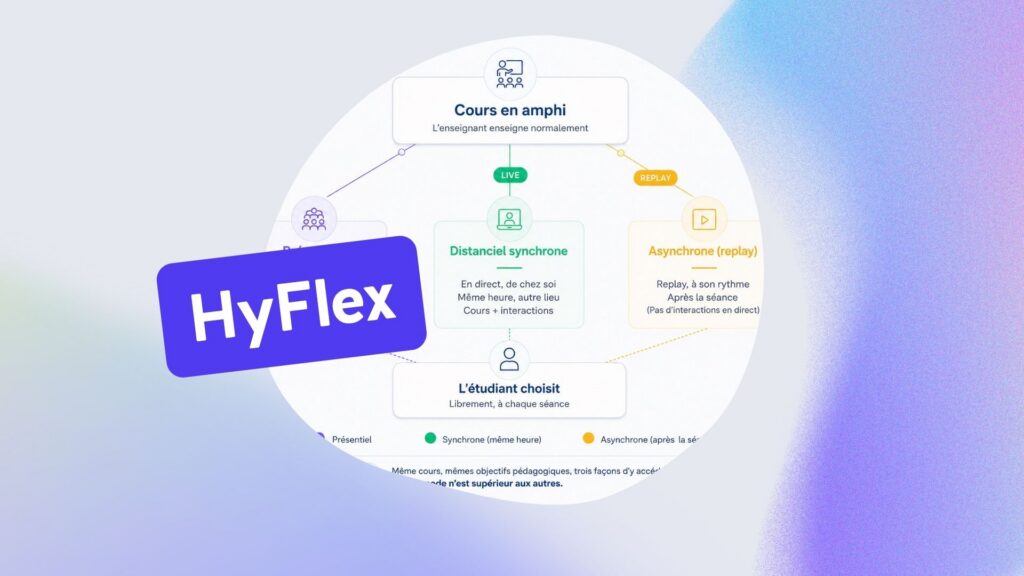
Beyond flawless video feedback quality and the ability to switch between feeds, the ideal HyFlex classroom incorporates a concept essential to its adoption: simplicity. Our concept of the ideal HyFlex classroom describes a space designed and equipped for simultaneous in-person and remote teaching, at a high level of performance. Such a room brings together all the technological elements seamlessly, in an automated way, almost invisible.
Ergonomics for the trainer guides every choice. They need to be able to control the tools and lead interactions with no unnecessary technical effort. Here, the goal is to automate everything, so the trainer can focus solely on delivering their class. For example, if needed, attendance tracking is automated for remote learners. Likewise, the online class session is directly integrated into the LMS, with no action needed from the teacher. And once the class is over, the session and the room’s equipment shut down automatically…
As you can see, the teacher is freed from technical constraints. They can devote themselves entirely to their teaching mission. Managing video and audio feeds, sharing content, and interaction tools are all centralized. Technology becomes a genuine ally in service of teaching.
What are the concrete benefits?
Adopting such an advanced blended learning environment transforms the experience. Remote learners are no longer mere passive observers — they become full participants in the training. They see, hear, and interact with a quality close to being in person. Group work combining on-site and remote participants becomes possible and more productive.
For trainers, the mental load associated with technical management is considerably reduced. They lead their sessions more spontaneously and naturally, with tools that make participation and individual tracking easier.
Finally, recording sessions at a professional quality level is an invaluable resource for the institution. Learners can revisit the content at their own pace, reinforcing knowledge retention.
An investment for the future
Setting up an effective solution for a hybrid teaching program comes with initial and ongoing costs. However, the medium- and long-term benefits are significant. Access to training expands for audiences who are sometimes geographically distant or facing mobility constraints.
The flexibility offered to learners is a competitive advantage that significantly strengthens the image of institutions that offer it. Finally, preserving knowledge through quality recordings builds a lasting educational asset.
This era calls for creating learning experiences that erase boundaries. Today’s technology makes it possible to build solid bridges between the physical world of the classroom and the digital space of remote participants.
It provides the means to design programs that are genuinely stimulating and rewarding for every individual. Successfully hybridizing a training program today means actively preparing the ground for tomorrow’s skills and ways of working.