Manifesto · May 2026
Towards a school with an enhanced sense of presence
When the classroom is no longer enough: A 47-page essay on what we buy before thinking through how it will be used…
- Open access
- CC BY-NC-ND 4.0 Licence
- HAL ref.: 05626888-v1
- 47 pages
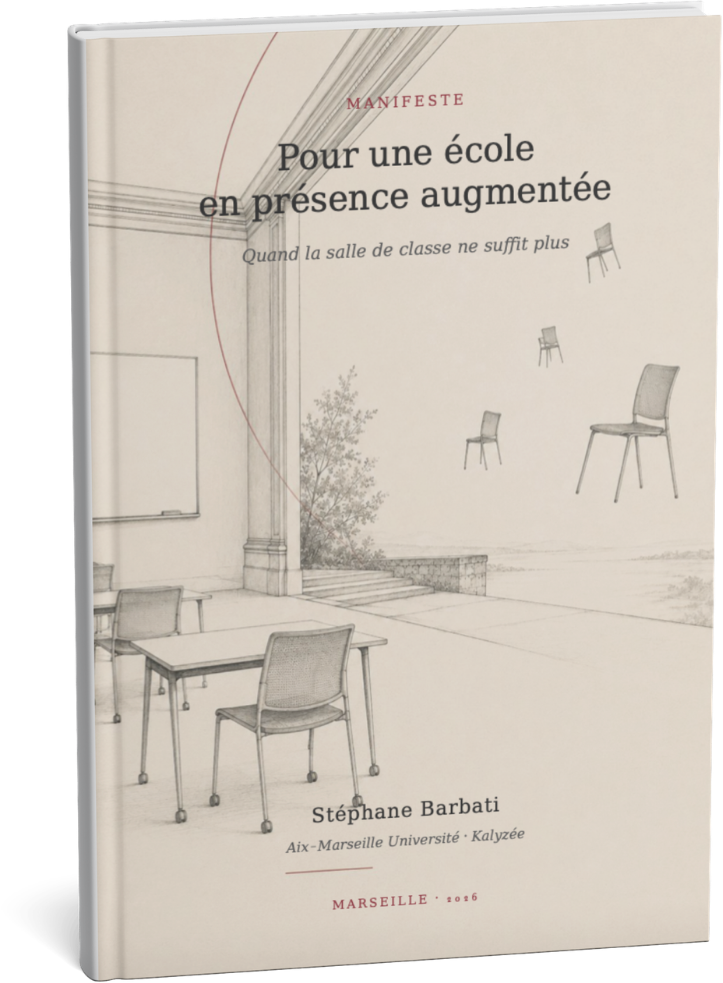
The argument
Our universities currently treat comodality as a matter of equipment. Cameras, microphones and screens are installed. Teachers are then asked to inhabit these systems. The order is backwards.
This manifesto argues the opposite: comodality is first and foremost a pedagogical act, before it is a technical one. What is at stake is not the quality of the video stream. It is the creation of a shared presence between people who are not in the same place.
Thinking of comodality as a policy of presence means asking, before any purchase: who can see whom? Who can interrupt whom? How is attention shared equally between the room and the screen? These questions do not appear on purchase orders. Yet they should come before them.
Across nine chapters, this manifesto brings together fieldwork (five years observing comodal systems in France and the French-speaking world), a thesis, a critique and a proposal: a framework for deciding before equipping.
Who this manifesto is for: public decision-makers, committed teachers, vice-presidents for digital strategy, L&D leaders, education researchers, heads of teaching support services, systems integrators — and anyone who still believes that the classroom is a political act.
The 9 chapters
Chapter I
Comodality is not videoconferencing
A comodal classroom does not begin with choosing software — it begins with a question about who is learning and from where.
Chapter II
The remote learner must not become a spectator
Chapter III
The teacher must not become the technical operator
Chapter IV
Chapter V
Chapter VI
Chapter VII
Chapter VIII
Chapter IX
Excerpts
A comodal classroom does not begin with choosing software — it begins with a question about who is learning and from where.
A comodal classroom is not a room that broadcasts. It is a room that sustains a relationship.
Pedagogical distance is not primarily spatial. What matters is not the number of screens, but the quality of the relationships the system enables.
The author
Stéphane Barbati
Senior Lecturer with habilitation to supervise research (HDR) · AMU — Co-founder · Kalyzée
A Senior Lecturer with habilitation to supervise research (HDR) at Aix-Marseille University (CNU section 31), he teaches, among other courses, the Student Personal and Professional Development module. He is co-founder of Kalyzée, an AMU spin-off specialising in comodal systems for higher education and vocational training.
It is from this dual perspective — as a researcher and a hands-on industry practitioner for ten years — that he offers a viewpoint seldom represented in the public debate on comodality.
Why Kalyzée is publishing this manifesto
The conviction of an author, not a supplier.
Kalyzée has been designing and deploying comodal systems in French-speaking universities, schools and businesses for more than ten years. This industry experience, combined with academic research, has led us to recognise that the quality of a comodal system is not determined by technical specifications. It depends on how organisations think through its use — or fail to do so.
Publishing this manifesto is our way of making this conviction public: we want to engage with our clients and the sector about the pedagogical purpose of the spaces we equip. Not just about price or image quality.
CC BY-NC-ND 4.0 — This text is freely accessible. No one commissioned it. No one is paying for it. It is an author’s essay, hosted by Kalyzée. Share it freely with attribution to the author — see the licence.
Join the discussion
Continue the conversation
Download, cite, share — and write to us.
Respond, cite, debate.
If you teach, make decisions, integrate systems or conduct research — and this text resonated with your own experience — write to Stéphane Barbati.
Your data is used only to respond to your message. No sales contact.